
GENERAL
Documentary Films on Hungarian Synagogues and Jewish Museums
A series of four films, made for TV, in which Rudolf Klein guides viewers to synagogues, Jewish Museums and a few other Jewish heritage sites in Hungary and Slovakia (in Hungarian). Click for:
Video 1 Video 2 Video 3 Video 4
In the Footsteps of the Wonder Rabbis
A heritage, online exhibit, and travel guide to Jewish heritage in northeastern Hungary — where several Hasidic masters once held court. Towns include Mád, Tokaj, Olaszliszka, Tarcal, Bodrogkeresztur, Sátoraljaújhely and places around them.
CEMETERIES
List of all Jewish cemeteries known to Mazsihisz, in Excel format, with addresses and contact numbers: there are at least 1300 Jewish cemeteries in all parts of Hungary, most of them neglected.
“Jewish Cemeteries” web site – izraelitatemetok.hu
Web site with documentation and photographs of more than 1,000 Jewish cemeteries around Hungary. (In Hungarian)
Database of Documentation of Jewish Cemeteries in Hungary
Lo Tishkach Report on Jewish Cemeteries in Hungary – February 2009
Download from here the PDF file of a report on the condition, state, threats and legislation regarding the at least 1,300 Jewish cemeteries in Hungary, prepared by Lo Tishkach.
SYNAGOGUES
There are scores of synagogues buildings in Hungary; some used as synagogues, some empty, some converted for other use. You can find further information than what we provide on this page by searching our web site for Hungary synagogues.
Documentary Films on Hungarian Synagogues and Jewish Museums
A series of four films, made for TV, in which Rudolf Klein guides viewers to synagogues, Jewish Museums and a few other Jewish heritage sites in Hungary and Slovakia (in Hungarian). Click for:
Video 1 Video 2 Video 3 Video 4
Synagogues designed by Lipot Baumhorn
Lipot Baumhorn (1860-1932) was modern Europe’s most prolific synagogue architect. He designed (or designed the restoration of) about two dozen. This article on centropa.org runs down 16 surviving Baumhorn synagogues.
OTHER
Web site and database relating to the work of the prominent Hungarian Jewish architect Bela Lajta, whose work included synagogue and ceremonial hall designs, sculptural tombs, a Jewish school in Budapest and other significant buildings.
Genealogy-oriented web site with information and photos on a number of Jewish sites in western Hungary and eastern Austria
BUDAPEST
A wealth of Jewish heritage sites, including active synagogues used by central Europe’s largest Jewish community. A score of synagogue buildings; medieval Jewish sites in Buda; downtown Jewish quarter in Pest (6th and 7th districts); Jewish cemeteries.
Medieval Sites in Buda
There are the remains of two Medieval Synagogues in the hilly Buda district of the city, near the Castle, on Tancsics Mihaly street — formerly known as “Jewish street.”.
One, at Tancsics Mihaly 26, is a small ground-floor chapel, from the end of the 14th century, that now can be visited in May through October as part of the Castle Museum. It has inscriptions on its walls and there is a display of Medieval and Turkish-era Jewish gravestones. Since late 2018 it has been used — after centuries — for services, organized by the Chabad-associated EMIH. (Tel: +36 1 268-0183)
The district’s monumental synagogue, built in 1461 and destroyed in 1686, stood on the opposite site of the street, in what is now the garden of Tancsics Mihaly 23. The ruins were discovered in 1964 by the archeologist for the Budapest History Museum, Laszlo Zolnay, but were filled in with earth and covered up again. Plans to excavate the synagogue as part of a development scheme for the Castle District are currently on hold.
The Schulhof Foundation for the Restoration of the Medieval Synagogue in Buda
Downtown Jewish District (7th Districts)
This inner city disrict was a main center of Jewish life from the early-mid 19th century onwards. It is anchored by three great synagogues (Dohany st.; Kazinczy st. and Rumbach st.) and includes other synagogues as well as kosher restaurants and other facilities. The district was also the site of the World War II ghetto.
Synagogues
Main synagogues in the 7th District
Dohany street synagogue (largest synagogue in Europe)
Dohány u. 2
Designed by the Viennese architect Ludwig von Förster and built in 1854-59, the grand, Moorish style synagogue is the largest in Europe and a city landmark.
Article on Bet Hatfutsot web site about the synagogue
Article by Haim F. Ghiuzeli about the history and architecture of the synagogue.
Web site about the courtyard of the Dohany st. synagogue and the Heroes synagogue, built next to it in 1930. The courtyard was used as a cemetery for Jews who died in the World War II Budapest Ghetto. The web site has lists of names, history, information and historic pictures.
Kazinczy st. 27
Used by the small, traditional orthodox community, the synagogue was designed by the architects Sandor and Lajos Loeffler and built in 1913 in a style that foreshadows art deco. It has an almost fortress-looking facade, decorated by decorative terracotta tiles, and a richly ornate interior. The synagogue anchors a self-contained Jewish courtyard, with a kosher restaurant and other facilities, including an outdoor frame for a chupah (wedding canopy).
Built in 1872, an early design by the Viennese architect Otto Wagner. The building has an octagonal sanctuary. Sold to the state by the Jewish community in 1988, the synagogue complex changed hands several times and long languished in semi-derelict condition following partial reconstruction in the late 1980s/early 1990s that was left unfinished for lack of funds. It was returned to Jewish ownership in 2006. The synagogue reopened in June 2021 following an award-winning, €10 million renovation, fully funded by the state, that was carried out in 2017-2019 and entailed the conversion of the synagogue and its entire building complex into a multi-purpose arts, culture, prayer, and education center.
Click to read our article from February 2022, on its 150th anniversary
Watch our video made for its 150th anniversay:
Elsewhere in the city
Budapest’s three grand main synagogues, located in the central part of the city on Dohány, Kazinczy and Rumbach streets, are local landmarks. But there are a more than a score of other synagogues scattered around the Hungarian capital, most of them home to active — if small — congregations.
See our series of three posts about synagogues all over Budapest:
Discovering Budapest’s lesser known synagogues. Part 3 – Stand-alone synagogues
Once known as the Chortkover Kloyz, a small prayer house originally founded by Hasidim from Chortkov, Galicia (today: Chortkiv, Ukraine), who came to Hungary after World War I, located in Budapest’s 8th district, once a populous Jewish neighborhood with many such little shuls. The current congregation is attempting to restore the Teleki ter Shtiebel through the Jakab Glaser Foundation, established in 2010.
Jewish Cemeteries
List of Jewish Cemeteries in Budapest with contact info
Article by Rudolf Klein
Kozma utca (Rakoskeresztur) Jewish Cemetery
Kozma utca 6
Budapest’s main (Neolog) Jewish cemetery, founded in 1891 and including some 300,000 graves. Many prominent people are buried here, and there is an extensive Holocaust memorial section. There is also a large, ornate, Moorish-style ceremonial hall. Much of the cemetery is well maintained, but large sections are still overgrown and untended. The perimeter is lined by elaborate family mausolea, some of them designed by leading architects in art nouveau and other styles.
“A Walk in Budapest Jewish Cemeteries”
Includes a clickable alphabetical list of personalities buried in the main Kozma utca Jewish Cemetery, with photos of their tombs
Friends of the Budapest Jewish Cemetery
American organization founded in 2016 to help fund cemetery clean-up
Salgótarjáni utca 6.
Tel: +36 1 896-3889, +36 1 896-3891, +36 1 896-3902, +36 70 400-8632
Founded in 1874, this is the oldest Jewish cemetery in the Pest side of Budapest. It is the Jewish section of the city’s Kerepesi monumental cemetery, where national heroes are buried — and is the final resting place of the crème de la crème of Hungarian Jewry of the time. Massive family tombs of Jewish noble families and industrialists line the perimeter; but there are also the graves of ordinary people. There is also a section where Holocaust victims are buried. Quite a few of the tombs are the work of leading architects of the day — such as Ignác Alpár, Sándor Fellner, Albert Körössy, Emil Vidor and Béla Lajta. Lajta, whose work prefigured art deco, also designed the entry way from the street and the massive Ceremonial Hall (now roofless), built around 1908. The cemetery has long been densely overgrown and very neglected, with the huge tombs crumbling; collapsing and being swallowed by vines and other vegetation. Some of them have been broken open: you can even see the coffins in the crypts. Restoration work, however, was begun in 2017.
See our photo gallery of this cemetery
Holocaust Monuments
There are several Holocaust memorials in Budapest, here are the main ones:
Memorial Weeping Willow next to Dohany utca synagogue
Holocaust Memorial and Memorial section in Kozma utca Jewish Cemetery
The main memorial lists the names of thousands of victims; people have penciled in names that were left out
“Shoes” memorial on the bank of the Danube
Memorial to Raoul Wallenberg
Memorial to the Swedish diplomat who save thousands of Jews by granting false papers
Memorial to Carl Lutz
Dob utca
Memorial to Swiss diplomat who saves Jews by granting false papers

Ghetto Memorial Wall memorial
Dohany utca 32-34
Erected to mark the 70th anniversary of the Holocaust in Hungary, and designed by by the architects Peter Sugár and László Kara. It includes a map of the Budapest Ghetto and inscriptions.
Holocaust Memorials — and Euphemisms — on the Danube Embankment
A thoughtful article by Rabbi Alfréd Schőner about how a series of Holocaust memorials erected on the Danube embankment only obliquely refers to the victims commemorated as Jews.
Other Jewish Buildings
Who Lived Here, Who Built Here
Extensive, interactive web site about buildings in Budapest designed by Jewish architects or constructed by Jewish builders. A project of OVAS!
A project recognizing buildings where Jews were forced to live before being moved into the Budapest Ghetto in WW2
NORTHEASTERN HUNGARY
The wine-growing region of northeastern Hungary has some of the oldest Jewish heritage sites in the country and was the home of several key Hasidic masters.
In the Footsteps of the Wonder Rabbis
A general exhibit and travel site that serves as a heritage, online exhibit, and travel guide to Jewish heritage in and around towns including Mád, Tokaj, Olaszliszka, Tarcal, Bodrogkeresztur, Erdobenye, Sátoraljaújhely.
On-site it is located in the complex of the restored synagogue in Mád (built in 1795) and the rabbi’s house/yeshiva next door, which includes a permanent exhibition as well as accommodation.
ELSEWHERE IN HUNGARY
There are well over 1,200 Jewish cemeteries and scores of synagogue buildings around Hungary. You can find information on these in the lists and databases linked to above. Following are key sites and sites with their own web pages.
ALBERTIRSA
Synagogue
Hunyadi ut
A simple rectangular building with a peaked roof, it was constructed in the early 1800s. The Center for Jewish Art writes that it was “built in 1820 in a combination of Neo-Classicist and Baroque styles. Its prayer hall, spanned by sail vaults, is devoid of interior supports. The vaults and walls were decorated with murals, some of them discovered and conserved during reconstruction works.”
Following World War II it was used for agricultural purposes, and almost all its interior fittings were lost. It had remained empty and in deteriorating condition for the past two decades, and became owned by the municipality in 2006: concerts were held there even before renovation commenced.
Renovation completed in 2017, funded almost completely by a Norway grant totaling around €930,000, transformed it into a “House of Arts” community cultural center.
Click to see Center for Jewish Art documentation of the building
APOSTAG
Synagogue
Iskola u. 5.
Tel: +36 78 427 227
Early neoclassical synagogue believed built in 1822. The original interior, with a central four-pillar bimah, and part of the decoration were restored in 1980s, in a project that won the Europa Nostra award. The synagogue is used the town library and culture center. There is a disused Jewish cemetery near the synagogue, across a field.
BAJA
Munkacsy Mihaly u. 9
Tel: +36 79 322 741
Neoclassical synagogue from 1845, designed by Lajos Frey, whose interior has been well preserved. Since 1985 the synagogue has served as the town library, with a large Holocaust memorial outside. The Hungarian postal service issued as stamp portraying the synagogue in 2012.
There is a large Jewish cemetery, at Szegedi ut 107.
Library web site (Hungarian and English)
BALASSAGYARMAT
The orthodox Jewish cemetery, located behind a stone wall on Temeto utca near the town’s Christian cemeteries, comprises about 3,400 tombstones dating back to the 18th century and was recognized as a national historic monument in 1994 (on the 50th anniversary of the deportation of local Jews to Auschwitz). It is one of the best-maintained Jewish cemeteries in Hungary, cared for by the local Kertesz Istvan Foundation, which is dedicated to preserving Jewish heritage. The Foundation has mapped, photographed and documented all the grave markers in the cemetery.
Pictures of the Jewish Cemetery
Ipoly Region Jewish Collection and Exhibition
24 Hunyadi u.
2660 Balassagyarmat
This small museum, which includes exhibits on local Jewish history and traditions, was created in 2000 and installed in the former Chevra Kadisha, a small peak-roofed building with a red and white facade.
Béla Majdán, Secretary of the advisory board of the István Kertész Foundation
Email: [email protected]
Tel: +36 30 583 2186 (Hungarian only: for English, contact the translator, Tel: +36 30 430 6779, Email: [email protected].)
CIGAND
General photos and photos of some individual gravestones in this village in northeastern Hungary; from web site on Jewish history and Holocaust in the town
DEBRECEN
Active Jewish community (the largest and most active in Hungary outside of Budapest); two synagogues; Jewish cemetery.
The Jewish community has organized a web site facilitating pilgrimage and tourism to Jewish sites in Debrecen and in Nagykallo, with history, maps, and other information.
Pilgrimage/Tourism web site (in English)
Downloadable Pilgrimage Brochure (English and Hungarian)
Thanks to a more than €1.41 million grant from the European Union’s European Regional Development Fund (ERDF), the Kápolnási street synagogue in Debrecen and and the Zion synagogue across the border in Oradea (Nagyvarad in Hungarian), Romania — were restored as part of religious tourism itineraries and cultural and educational programs. The project comes within the framework of the Hungary-Romania Cross-Border Cooperation Program. (See our post about the project)
Jewish heritage sites in Debrecen
List in English on the Jewish community “Pilgrimage” web site, describing the two synagogues, the Beit Midrash, the Jewish cemetery and other sites.
Built in 1909-1910 for the Status Quo Ante community, designed by the Budapest-based Laszlo brothers in an eclectic style with a distinctive arched entryway. Located in a shady garden, it is used now mainly for community events, rather than regular weekly services.
Pásti street Orthodox Synagogue
Built in 1913, it has a simple interior and a bold brick and stucco façade marked by arched doorways and false arcades along the peak of the roof. It was re-opened in April 2015 after full restoration, to serve both for religious purposes and also a cultural space for exhibitions, conferences, concerts. There is a permanent exhibition of Judaica and family memories.
Jewish Cemetery
Monostorpályi út, 44
Tel:+36-52-471-744, +36 20 483 27 61
GPS: 47°30′44.51″ É (N) – 21°38′19.21″ K (E)
GIS mapping of Debrecen Jewish cemetery
Slide show of Jewish heritage in Debrecen
GYŐR
Grand synagogue, which has been restored for cultural use. It was built in 1869 and designs bynthe architects Károly Benkõ and Villmos Fraenkl.
PÉCS
Synagogue
Located on downtown Kossuth square, the synagogue was designed by the architects Frigyes Feszl, Károly Gerster, and Lipót Kauser and built between 1866 and 1869; the synagogue was dedicated on July 22, 1869. Its tripartite, peach colored façade features tall arched windows and a high, arched central section, framing a big clock and topped by the tablets of Moses. Around the top of the clock runs a Hebrew quotation from the book of Isaiah: “For my house shall be called a house of prayer for all people.” Inside, the two tiers of the women’s galleries, supported by cast iron columns, have beautifully decorated ceilings, and there is a choir loft and organ.
In September 2014 a permanent exhibit on Jewish life and history in Pécs and surrounding Baranya country from the 18th century to the present was inaugurated in the women’s gallery and stairwell of the synagogue.
Synagogues360 panoramic view of the synagogue interior, and other pictures
World Monuments Fund pages on the synagogue, with architectural and historical information
SOPRON
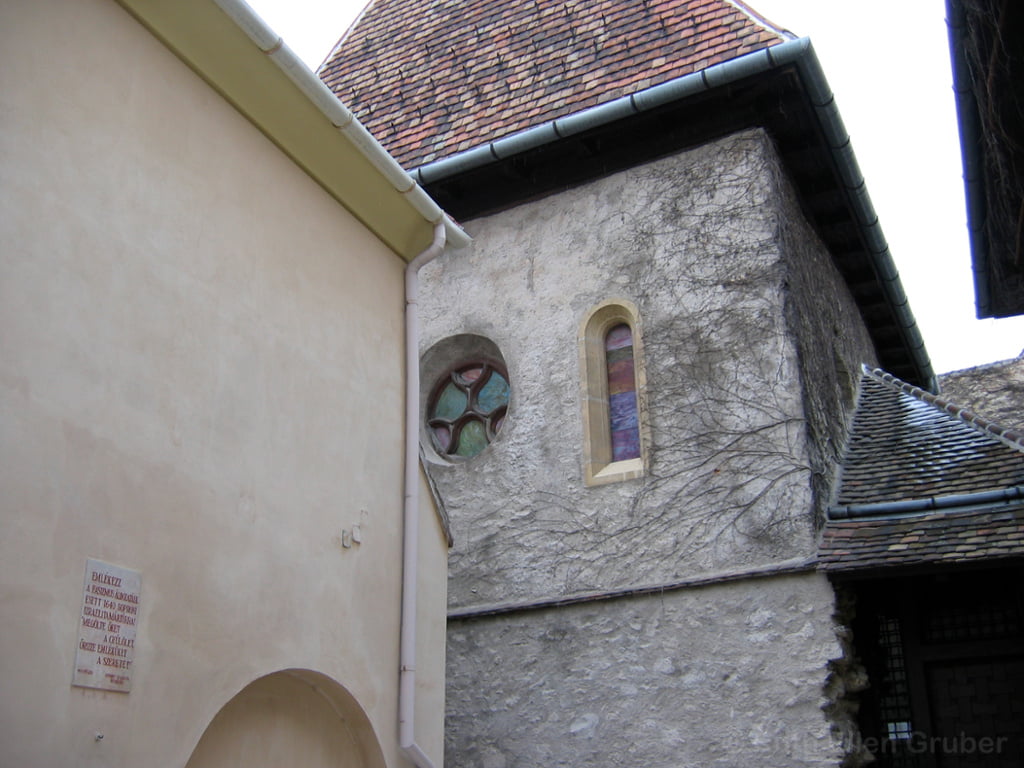
Jews lived in Sopron from early medieval times until their expulsion in 1526. They returned in the 19th century, forming a community of nearly 2,000 Jews on the eve of World War II; almost all were killed. The town retains evidence of both the medieval and modern Jewish presence.
The two oldest synagogues in Hungary face each other on the onetime Jewish street, now called Uj utca (New street). Both date from the 14th century; both were transformed and used as private dwellings for centuries, and both were re-discovered and restored between the 1950s and 1970s. The gothic Old Synagogue at No. 22 Uj utca (Tel: +36 99 311 327), with a high peaked roof, richly carved Ark and foundations of the bimah, was restored in 1967 and serves as a Jewish Museum. The complex also includes a mikvah. The “New” Synagogue, built around 1370 as the private prayer house of a Jewish banker, is found across the street at No. 11 (but does not form part of the museum).
A disused dome-topped red-brick synagogue built in 1890-91 and designed by Janos Schiller stands at Papret Square, outside the town center.
The park/parking lot in front of it has a sculptural Holocaust memorial, and there are commemorative plaques on the synagogue’s wall.
The large Jewish cemetery on Tomalom utca near St. Mihaly’s church dates from the 19th century. It has a large Holocaust memorial.
SZEGED
Two synagogue buildings; Jewish community and active community complex with prayer room; large Jewish cemetery with ceremonial hall.

Szeged’s magnificent domed Great (New) Synagogue was designed by Budapest-based Lipot Baumhorn (1860-1932), Europe’s the most prolific synagogue architect, and completed in 1903. It was built for the Neolog community and is considered Baumhorn’s masterpiece.
The architect worked closely with the Szeged Rabbi, Immanuel Löw, on the richly ornamental and symbolic decorative elements, which include stained glass by Miksa Roth and a monumental organ. The synagogue is set in a parklike square, whose plantings, a Biblical garden, also were part of the design. Today, a marble plaque in the vestibule lists Holocaust victims from the town.
Next to the Great Synagogue is the former Orthodox (Old) Synagogue, a neoclassical building designed by Henrik and Josef Lipowsky and completed in 1843. Listed as a cultural monument, it is owned by the local government and currently used for cultural purposes.
The Great Synagogue is part of a nearby Jewish communal complex also designed by Baumhorn that includes a prayer room that is also richly ornamented, and a gala hall. Baumhorn also designed the domed Ceremonial Hall in the large Jewish Cemetery. The cemetery includes the temple-like tomb of Rabbi Lipot Löw, one of the pioneers of Neolog Judaism in Hungary.
Contacts – click here for full list
Great Synagogue
Gutenberg u. 20
6722 Szeged
Tel: +36 62 423 849
Old Synagogue
Hajnóczy u. 12
6722 Szeged
Jewish cemetery
Fonogyari ut 9.
6728 Szeged
Tel: +36 70 542 0961
Jewish Community Office
Jósika u. 10
6722 Szeged
SZOMBATHELY

Grandiose, Moorish-style former synagogue, with two big towers, built in 1880 and desgiend by Ludwig Schone, that has long been used as a concert hall. The synagogue preserves two large, dome-topped towers and a lavishly decorated exterior. A Holocaust memorial stands next to it
There is also small prayer hall and culture center used by the Jewish community; Jewish cemetery; other buildings.
Jewish community and visitors center
Zrinyi Ilona street 17
Tel: +36 30 434 757
Email: [email protected]
Opened in 2013, the visitor center has a permanent exhibition on local Jewish history. On the web site there are links and descriptions to other heritage in the city.
Jewish heritage and history in Szombathely
Web site with documentation, history, photographs of religious sites as well as urban architecture.